Updating my Dividend Quality Scoring System
I use a quality scoring system modeled after David Van Knapp's elegant Quality Snapshots. This article describes my (updated) system and how I rank dividend growth stocks by quality scores.

Introduction
I use a quality scoring system modeled after David Van Knapp's Quality Snapshots, an elegant system for assessing the quality of dividend growth stocks.
This article describes my (updated) quality scoring system and how I rank dividend growth stocks by quality scores. It also explains how my system differs from Quality Snapshots.
David and I have corresponded many times in the past five years, seeking ways to improve Quality Snapshots. He welcomed my use of Quality Snapshots and encouraged experimentation, perhaps anticipating that we'd want to use different quality indicators and scoring systems.
In 2022, I replaced one quality indicator, added another, and changed how quality indicators are scored. I used the resulting quality scoring system for over two years to manage my portfolio and write articles on dividend growth investments.
Recently, David replaced one of two Value Line quality indicators with a quality indicator from Seeking Alpha. This change is compelling, as it adds a quality indicator dear to the financial world (profitability) and eliminates the outsized contribution that Value Line made to quality scores.
I'm following David's lead by replacing one of Value Line's quality indicators with Seeking Alpha's Profitability Grade.
Methodology
There are many ways to define dividend quality, but David proposed using independent quality indicators from trusted information sources. His Quality Snapshots system employs five quality indicators and assigns 0-5 points to each, for a maximum of 25 points.
I use the same quality indicators as Quality Snapshots, but I added a sixth quality indicator from Portfolio Insight:
- Value Line [VL] Financial Strength rating
- Morningstar [MS] Economic Moat
- S&P Global [SP] Credit Ratings
- Simply Safe Dividends [SS] Dividend Safety Scores
- Portfolio Insight [PI] Dividend Quality Grade
- Seeking Alpha [SA] Profitability Grade
The Financial Strength rating measures a company's financial condition. It is reported on a scale of A++ to C. VL considers fundamentals such as net income, cash flow, debt to equity, profit outlook, industry stability, and company return to assign ratings. Ratings of B or B+ are considered average. The lowest rating of C is reserved for companies in severe financial difficulty.
The Economic Moat is a proprietary data point from MS that reflects a company's sustainable competitive advantage. A company with a wide economic moat can fend off competition and earn high returns on capital for at least 20 years, whereas a narrow-moat company can do so for at least 10 years. A no-moat company has either no advantage or one that will quickly dissipate.
The Credit Ratings from SP are forward-looking opinions about debt issuers' ability and willingness to meet their financial obligations on time and in full. Credit ratings address creditworthiness rather than investment merit. The rating scale ranges from AAA to D, with BBB- and higher considered investment grade ratings, and BB+ and lower regarded as speculative grade.
The Dividend Safety Scores predict dividend risk over a complete economic cycle. SS determines scores based on an analysis of dividend-related metrics, including payout ratios, debt levels, recession performance, dividend longevity, industry cyclicality, free cash flow, and analyst estimates. Scores range from 0 to 100:

With the Dividend Quality Grade, PI differentiates between companies likely to increase their dividend during the next 12 months and companies at risk of freezing or cutting their dividends. Grades range from A+ to F, with F indicating companies at significant risk of cutting their dividends. PI considers earnings, revenue, dividend performance, and performance and financial strength metrics to assign the grades.
The Profitability Grade measures the company’s profitability relative to other stocks in its sector. It is derived by comparing a stock’s profitability metrics (including gross and net profit margin, return on equity, return on assets, asset turnover, and net income per employee) to those of other stocks in the sector. The overall profitability grade is an aggregate of the grades of underlying metrics. Grades range from A+ to F.
Quality Scores
Similar to Quality Snapshots, I assign 0-5 points to each quality indicator. With six quality indicators scoring up to 5 points each, the maximum quality score is 30 points.
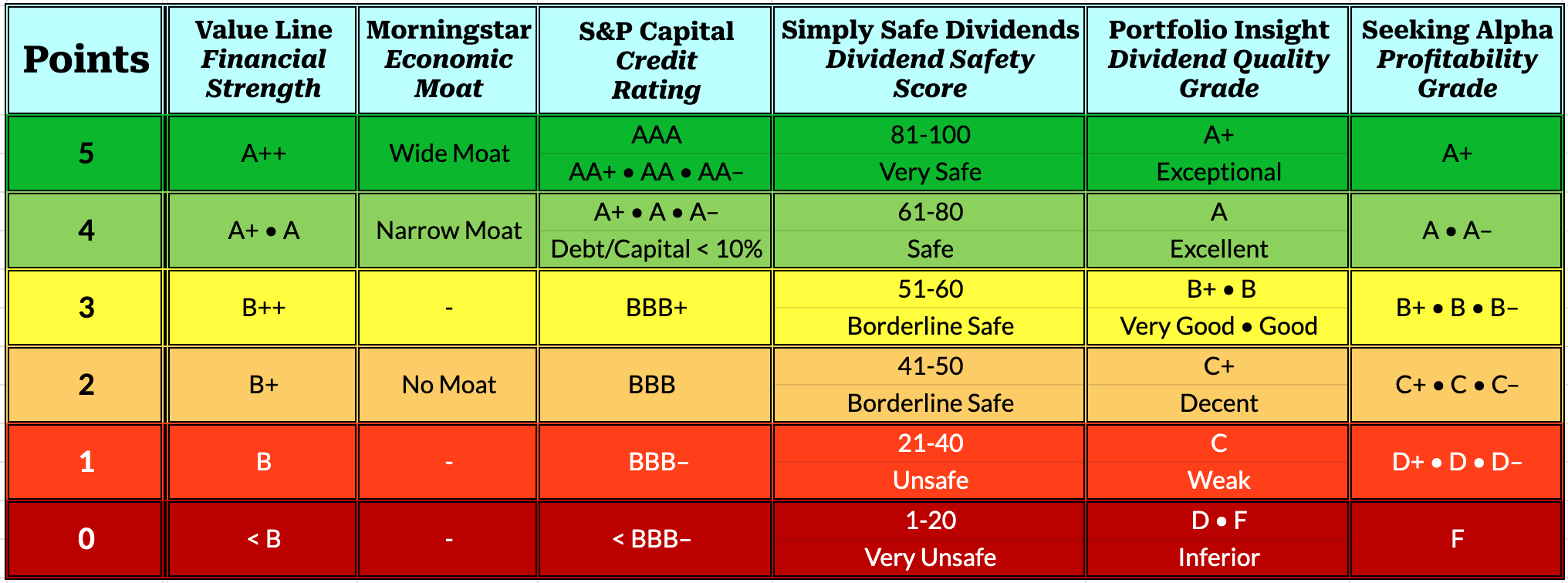
I considered the distribution of scores of more than 700 dividend growth stocks in Dividend Radar to assign scores to each quality indicator:

Generally, only the very best ratings and highest scores earn 5 points. Some quality indicators do not map to every point in the scoring system. For example, MS distinguishes between wide, narrow, and no moats. The scoring system assigns 5 points for wide moats, 4 for narrow moats, and 2 for no moats.
SP considers stocks with credit ratings of AAA through BBB– as investment-grade stocks. If a stock doesn't have a credit rating, it gets no points unless its Dept/Capital < 10%, in which case it earns 4 points.
The five categories of Dividend Safety Scores are split into four safe and two unsafe categories. I'm splitting the Borderline Safe category into two halves that score 3 and 2 points, respectively.
How my approach differs from Quality Snapshots
- Six quality indicators instead of five
– I added PI's Dividend Quality Grade, which provides a data-driven approach to determining the likelihood of dividend increases in the next 12 months and the risk of dividend freezes, cuts, or suspensions. - Quality indicators are scored differently
– I consider the distribution of scores of Dividend Radar stocks when assigning scores to each quality indicator. I assign 5 points only to the very best ratings and grades and other points to mimic a “normal distribution” (with more stocks scoring 3 and 2 points than either 5 and 4 points or 1 and 0 points). That’s not possible for all the quality indicators.
Quality Ratings
As mentioned earlier, the maximum quality score is 30 points. I distinguish between the following ratings depending on a stock's total quality score:
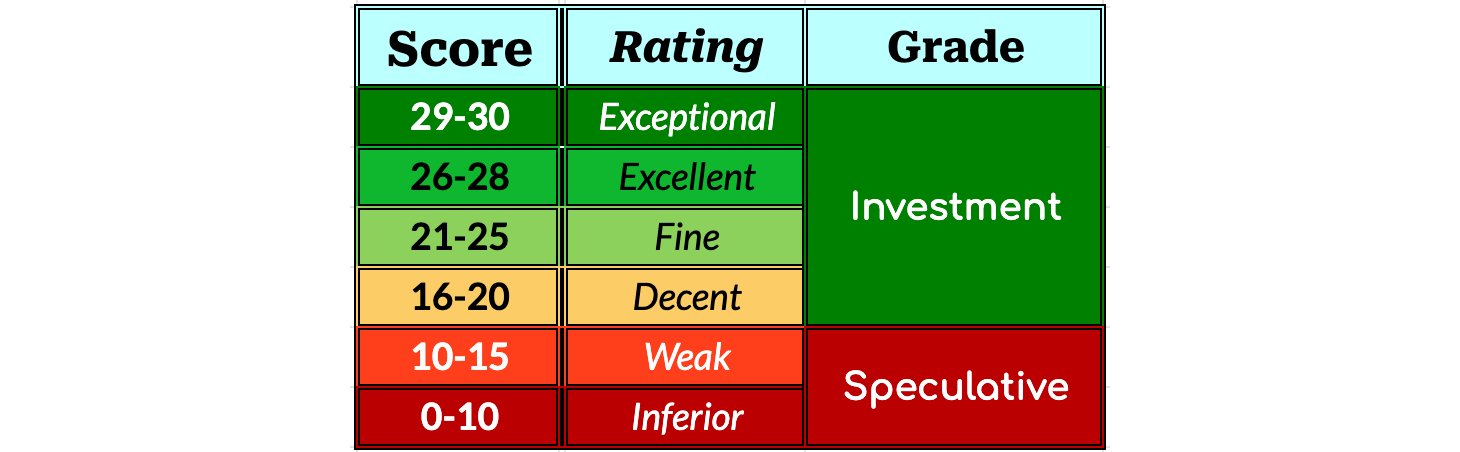
Generally, I invest in stocks rated Exceptional, Excellent, and Fine. In some circumstances, such as with high-yielding defensive stocks, I'll also consider stocks rated Decent.
I consider stocks with quality scores in the range of 16-30 to be Investment Grade stocks, while stocks with quality scores below 16 are Speculative Grade stocks.
Ranking Stocks
I frequently write articles about dividend growth stocks with similar characteristics, such as the Dividend Kings (stocks with dividend increase streaks of 50+ years) and the Dividend Aristocrats (S&P 500 stocks with dividend increase streaks of 25+ years). In such articles, I like to rank the stocks for presentation purposes.
To rank dividend growth stocks, I sort them in descending order by the quality score and break ties by considering the following factors in turn:
- SS Dividend Safety Scores
- SP Credit Ratings
- Forward Dividend Yield
For example, six stocks were rated Exceptional when I wrote this article.
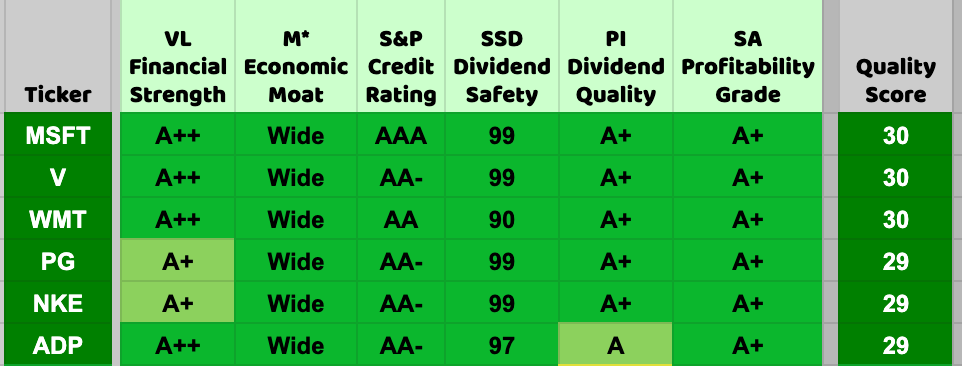
- Microsoft [MSFT], Visa [V], and Walmart [WMT] have perfect quality scores of 30. I first consider their Dividend Safety Scores noting that MSFT and V both score 99, while WMT scores 90. So WMT is ranked third. To break the tie between MSFT and V, I compare their Credit Ratings. MSFT is the only stock with a AAA credit rating, so MSFT is ranked first and V second.
- There are three stocks with quality scores of 29, Procter & Gamble [PG], Nike [NKE], and Visa ([V], and Automatic Data Processing [ADP]. PG and NKE have Dividend Safety Scores of 99, whereas ADP scores 97. So ADP is ranked sixth. The next tie-breaker is Credit Ratings, but both PG and NKE have AA- credit ratings. So the final tie-breaker, Forward Dividend Yield, is needed. PG (2.44%) tops NKE (1.91%), so PG is ranked fourth and NKE fifth.
Conclusion
For DivGro 2.0 and all future articles on dividend growth stocks, I'll be using this updated variation of Quality Snapshots to assess the quality of dividend growth stocks. The update replaces VL's Price Stability with SA's Profitability Grade.
With six quality indicators and a maximum score of 5 points per quality indicator, my quality scoring system has maximum quality score of 30 points.
As before, I'll look to invest in stocks rated Exceptional (29-30 points), Excellent (26-28 points), and Fine (21-25 points). I'll also consider attractive, high-yielding defensive stocks rated Decent (16-20 points).
In the 1 November 2024 edition of Dividend Radar, there are 6 stocks rated Exceptional, 46 stocks rated Excellent, and 167 stocks rated Fine, for a total of 219 high-quality dividend growth stocks. Adding 161 stocks rated Decent, there are a total of 380 stock I consider to be Investment Grade (54% of all Dividend Radar stocks).
Please note that the main purpose of using a quality scoring system is not to make final buy or sell decisions, but to identify candidates for further research. The scoring system is stringent but that doesn't mean the highest-quality stocks are always suitable for investment. Valuation is crucial, and must be considered after vetting a candidate's suitability through further research.
My ranking system uses quality scores and three tie-breaking metrics. I use the rankings of candidate only to help determine the order in which to do further research.
Thanks for reading, and happy investing!
You can follow me on Twitter, Facebook, Seeking Alpha, and TalkMarkets.